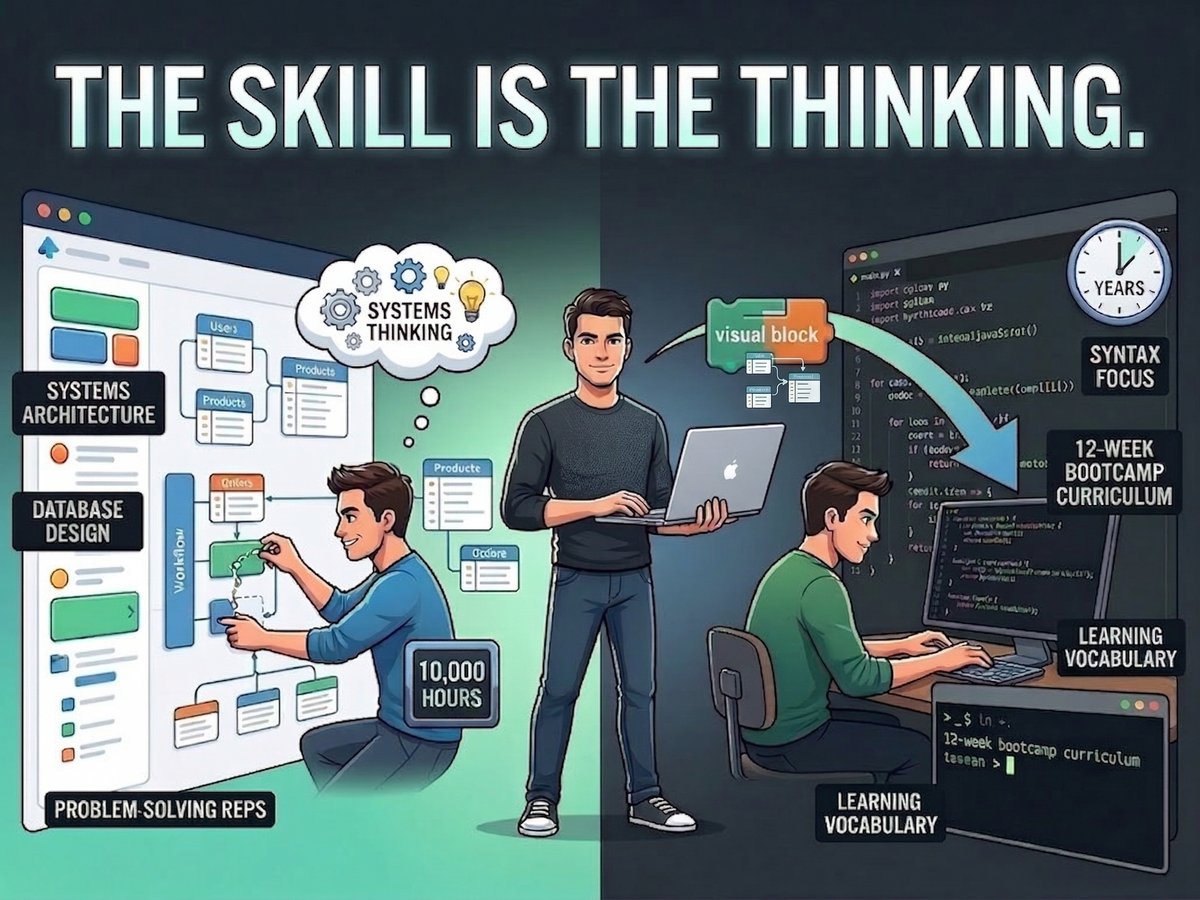

Most people treat no-code like the training wheels version of coding. I spent 10,000+ hours in Bubble, and I can tell you: the training wheels comparison is backwards. No-code doesn't hide the hard parts of building software. It forces you to face them on day one.
Here's the thing. A coding bootcamp teaches you syntax. A decade of shipping real apps in Bubble teaches you how to structure a system. Those are not the same problem, and the second one is the one that actually matters.
This post does three things. It defines what no-code developer skills actually are. It answers the identity question every no-code builder secretly has. And it gives you a 3-test framework for deciding when to use no-code, when to use code, and when to mix them.
Is No-Code Real Coding?
Yes. No-code is a different syntax for the same problem -- structuring data, designing workflows, managing state -- that all real software is made of. The tool hides the typing. It doesn't hide the thinking.
That's the featured-snippet answer. Here's the longer version.
People who dismiss no-code usually haven't built anything real in it. In Bubble, the visual data model is in your face from minute one. You can't just hack something together. You have to understand your data types, your workflows, your privacy rules, before the UI will make any sense.
That's architecture. That's the exact skill most coding bootcamps skip, because their curriculum is measured in weeks and real architecture takes years.
So is no-code real coding? The wrong question. The right question is: does it teach you to think like someone who ships production software? And that answer is a clean yes.
The No-Code Developer Skills That Actually Transfer
Four skills. Each one shows up in every production stack, not just Bubble.
1. Data modeling before UI
In Bubble, you can't hide the schema. You model data types, privacy rules, and relationships before the first page renders. Example: on Modliflex (one of NocodePro's own products, live and multi-user), the subscription tier logic lives in the data model. One source of truth. Every page reads from it. Change a tier, everything downstream updates.
The equivalent in code is designing your database schema before you write a single API route. Most bootcamp grads skip this and pay for it six months in.
2. Constraint-driven decisions
When the tool can't do everything, you commit. Bubble can't render documents server-side at scale. If your app needs that, you reach for an external service (n8n + Gotenberg, Modal, whatever fits) up-front -- not three weeks into the build.
That commitment muscle is exactly what separates senior developers from juniors. Seniors decide. Juniors defer.
3. User state across many screens
Bubble forces you to think about what the user "is" at every moment. Trial user? Active subscriber? Paused? Admin? An onboarding flow where the user's state drives what every screen shows -- that's the entire architecture of any real SaaS product. Bubble makes you design it visibly. Code lets you hide it, which is usually how bugs start.
4. Shipping over optimizing
I've rebuilt the same feature ten different ways over five years. Bubble makes rebuilds cheap, so you learn to ship working systems before polishing them. That translates directly: in code with an AI agent like Claude Code, the fastest devs are the ones who ship v1, see real usage, then rebuild. Not the ones who architect for six months before shipping anything.
These four skills -- data modeling, constraint-driven decisions, user state, shipping -- don't vanish when you leave the visual editor. They're what makes you fast everywhere else.
Why I Still Work in Both -- and When Each One Wins
Let me correct something before going further. I haven't "left" Bubble. I still ship Bubble apps today, and so does NocodePro. Three streams of work:
- Our own apps. Modliflex runs on Bubble (live, multi-user creator platform). LumiDevKit and ReplayDoc run off Bubble, on coded stacks. Same builder, same systems thinking, different tool per product.
- Bubble services for clients. Bubble app development, Bubble app audits, and consulting on Bubble apps. These are Bubble by definition. The service exists because Bubble is the right layer for the product.
- AI automation for clients. We pick the tool that fits the specific problem. Usually not Bubble. Often n8n, Next.js, or a custom stack with Claude Code. Bubble is rarely the right layer for automation itself.
I'll say that second part plainly, because most agencies get it wrong: we do not do AI automation on Bubble. We do Bubble work on Bubble and automation work on whatever tool fits. Picking the right tool per job is the whole point.
Same builder. Different tools. Picked per job.
The hybrid move -- mixing tools on one project
This is the part most comparison posts miss. The real leverage isn't picking one side. It's mixing them on purpose.
Extend Bubble's backend with serverless. Plug n8n, Trigger.dev, or Modal into a Bubble app to do what Bubble can't -- long-running pipelines, heavy compute, ML inference, anything async and resource-intensive. The app stays in Bubble. The hard work happens elsewhere. Bubble's limits disappear, because you stopped asking Bubble to do things it was never good at.
Use code where SEO and performance matter. Keep Bubble where iteration matters. Build the public-facing marketing, landing, and blog pages in Next.js -- 100 Lighthouse score, instant page loads, great SEO. Keep the authenticated product inside Bubble where you can iterate on workflows in an afternoon. Google loves the public pages. Users get the app's speed-to-iterate. Best of both layers.
Most people get this wrong because they treat it as a team-picking exercise. "Are you Team No-Code or Team Real-Code?" Wrong frame. It's a per-layer decision.
Where each tool wins
Honest version:
- Bubble wins when the data model is relational, iteration speed matters more than milliseconds, and the owner wants to keep changing the product themselves.
- Code wins when requirements are highly custom, real-time matters, public-page performance matters, or the app needs to own its code outright.
- Hybrid wins more often than either purist answer.
Bubble hits a wall when you need real-time sync across thousands of concurrent sessions, or when compute gets serious. Code makes you pay up-front for things Bubble hands you for free -- auth flows, a database UI, a visual workflow engine. Which is exactly why I stopped treating them as rivals and started treating them as layers.
When to Use No-Code vs Code: The 3-Test Framework
Three questions. Apply them per layer of the app, not just per project. One app can pass all three for Bubble on the product side and fail all three on the public-pages side. Normal. Mix accordingly.
1. Timeline test
If this layer needs to be in users' hands within 2-6 weeks, Bubble usually wins. Coded builds take 3x the calendar time, even with AI agents helping. The AI agent speeds up typing, not deciding.
2. Maintainability test
Who maintains this layer? If the owner is non-technical and there's no in-house dev team, Bubble wins -- a non-developer can actually change a Bubble app. If a dev team will own and extend it, code opens more doors.
3. Custom-requirements test
Can this layer's core work be expressed in Bubble's primitives? If yes, Bubble wins. If the layer needs real-time sync, custom auth flows, long-running async pipelines, ML inference, or public-page SEO with top-tier performance scores -- code or a hybrid wins.
The hybrid takeaway
If the whole app fails one test, that's not a reason to abandon Bubble. It's a reason to mix. Keep Bubble where it passes (usually the authenticated app). Layer code where it fails (public pages, heavy async, compute, ML). Same project, multiple tools, right tool per job.
FAQ
Is no-code real coding? Yes. No-code is a different syntax for the same problem -- structuring data, designing workflows, managing state. Every production no-code app is doing real software engineering. The tool hides the typing. It doesn't hide the thinking. Anyone who dismisses no-code hasn't shipped anything real in it.
Can no-code build production apps? Yes. Modliflex runs on Bubble, live and multi-user, today. NocodePro also delivers Bubble apps for clients in regulated and long-lived production contexts. Bubble scales further than most critics think. The ceiling is real, but it's much higher than "hobby projects."
Should I learn to code after no-code? Depends on what you want to build next. If you want to be a builder who ships things people use -- no, you don't have to. If you want to take on projects where Bubble can't reach (custom real-time, ML inference, millisecond-level performance), then yes. And AI-coding agents like Claude Code shortcut that path enormously if you already have the systems-thinking skills from no-code.
What This Means for You
If you're building an app right now -- in Bubble, Webflow, Glide, or any other no-code tool -- you are not cheating. You are building. Every hour of real-world problem-solving makes you a better builder, no matter which tool you're holding.
The tool is not the skill. The skill is the thinking. And the best move in 2026 isn't picking a camp -- it's knowing which layer wins on which tool, and mixing without apology.